

Updated: October 29, 2026

BPC-157, TB-500 and other so-called wellness peptides are increasingly marketed for injury recovery, muscle growth, inflammation and longevity. A new U.S. Department of Health and Human Services (HHS) draft policy has brought the topic back into the headlines—but a change in compounding enforcement is not the same as FDA approval, and it does not establish that a peptide works.
The distinction matters. Some claims about these compounds come from animal studies, early laboratory research or small human reports. That is not enough to show that a product safely speeds muscle recovery, treats an injury or extends human lifespan.
Quick answer: What has changed in the United States?
On October 28, 2026, HHS posted an interim draft enforcement-discretion policy concerning six peptide substances used in certain compounded drugs. The related Federal Register notice is scheduled for publication on October 30, 2026, and the notice says public comments may be submitted for two weeks after publication.
The six substances named are BPC-157, epitalon, KPV, MOTS-c, Semax and TB-500. Under specified conditions, HHS says it does not intend to take enforcement action against certain state-licensed pharmacies, federal facilities or licensed physicians compounding products with those substances while the FDA continues rulemaking.
This is not FDA approval. The draft is not binding on HHS or the public, may be revisited if safety or product-quality concerns arise, and does not prove that the compounds are effective for recovery, muscle growth or longevity. Read the HHS interim policy and the Federal Register notice for the regulatory details.
Why this matters today
Peptides are being discussed as shortcuts to faster recovery, better body composition and healthier aging. That interest creates a real information problem: marketing claims can move faster than clinical evidence, while a regulatory change can be misunderstood as a safety endorsement.
The current HHS document concerns a narrow pathway for certain forms of compounding under Section 503A of federal drug law. It does not turn every peptide sold online into an approved medicine, and it does not make every route or formulation permissible. The policy also does not replace the need to understand the evidence for each individual compound.
For readers, the practical question is not simply whether a peptide is trending. It is whether reliable human studies show a meaningful benefit for the specific use being promoted, whether the product and route have been studied, and what is known about short- and long-term risks.
What are peptides—and are all peptides experimental?
Peptides are short chains of amino acids. The term describes a broad group of molecules, not a single treatment category. Some peptide-based medicines are approved for specific medical indications. That approval does not transfer to a different peptide, a different formulation or a different use promoted by wellness clinics or online sellers.
The compounds discussed in the current policy are often marketed for uses such as tissue repair, exercise recovery, inflammation, metabolism or aging. For those uses, the evidence varies by compound and is frequently limited. A biological effect in a cell or animal model may help researchers decide what to study next, but it cannot by itself establish that a treatment is safe or effective in people.
What the draft policy says about the six peptides
The policy does not cover every peptide, every seller or every formulation. Its Appendix A names six substances, while Appendix B specifies particular forms and routes. Not all six are injectable.
| Peptide named in the policy | Forms or routes described in the draft | Important evidence caveat |
|---|---|---|
| BPC-157 | BPC-157 acetate: subcutaneous, intramuscular, oral or topical forms | Human evidence for recovery and orthopedic uses remains very uncertain. |
| TB-500 | TB-500 acetate: subcutaneous or intramuscular injection | Human safety and efficacy evidence for the marketed recovery claims is extremely limited. |
| Epitalon | Epitalon acetate: subcutaneous or intramuscular injection, dispensed in intermittent courses | Longevity claims are not established by adequately powered clinical trials. |
| KPV | KPV acetate: topical or oral forms | FDA briefing materials reviewed by outside analysts identified no human safety studies for KPV in the materials they assessed. |
| MOTS-c | MOTS-c acetate: subcutaneous or intramuscular injection | Evidence for metabolic, muscle or longevity benefits in humans remains insufficient. |
| Semax | Semax free base: intranasal use | It is not an injectable option under this draft and is not established as a muscle-recovery or longevity treatment. |
These route details are a summary of the draft policy, not instructions for use. The policy also describes conditions involving a patient-specific prescription, a registered original manufacturer, a valid certificate of analysis, manufacturing-quality requirements, reporting of serious adverse events and product-quality problems, and a single active ingredient per compounded product. Oral formulations have an additional documentation expectation regarding bioavailability in humans. See the full HHS policy and appendices.
What does the human evidence actually show?
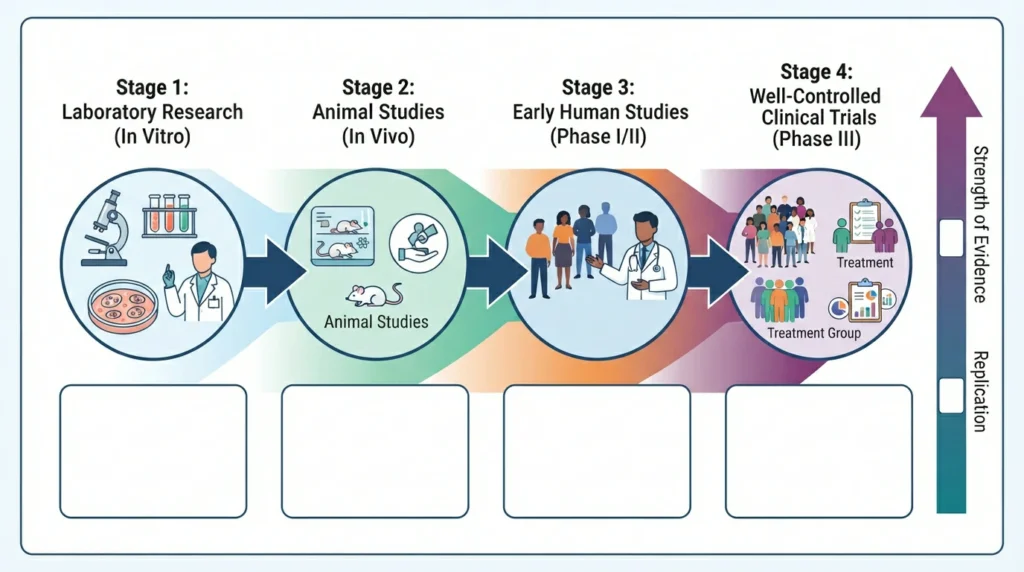
BPC-157: promising hypotheses are not proof of recovery
BPC-157 is frequently promoted for tendon, muscle, joint and other tissue recovery. Much of the supportive research has involved animals or preclinical models, which cannot establish the same effect in humans.
A systematic review published in October 2026 identified three human studies relevant to orthopedic or regenerative uses, with a total of 30 participants across the studies it included. The studies were small and methodologically weak, and the authors rated the certainty of evidence as very low. They concluded that the evidence does not support clinical use outside appropriately regulated, ethically approved, high-quality trials. Read the systematic review indexed in PubMed.
That finding does not prove BPC-157 has no biological activity. It means the available human research is not strong enough to establish that it safely and reliably improves recovery or other outcomes.
TB-500, KPV and MOTS-c: major evidence gaps remain
TB-500 is promoted for tissue repair and recovery; KPV is discussed in connection with inflammation and wound healing; MOTS-c is often marketed around metabolism and longevity. These are claims that need to be evaluated separately rather than treated as one shared “peptide benefit.”
An analysis in Health Affairs of FDA briefing materials prepared for the July 2026 advisory committee meeting reported that it found no human safety studies for KPV, TB-500, MOTS-c or epitalon in the materials reviewed. The same analysis described the human data for BPC-157 and Semax as limited, with incomplete safety reporting or short treatment periods. HHS’s later draft policy discusses additional information about historical use and product characterization, but that does not amount to large controlled trials proving the marketed benefits.
The FDA’s own compounding safety page describes concerns that can include limited route-specific safety information, peptide-related impurities and possible immunogenicity. The exact concerns differ by substance and formulation.
Epitalon and longevity: no proven lifespan extension
Epitalon is promoted in some longevity circles as a way to influence aging-related biology. Mechanistic findings and changes in biomarkers are not the same as evidence that a treatment helps people live longer or remain healthier as they age.
A 2026 review of epitalon and related evidence reported that human data remain limited and that no adequately powered randomized trial has established therapeutic efficacy. Pharmacokinetic, dose-ranging and long-term safety questions also remain. These gaps mean that claims of proven human longevity benefits are not justified by the available evidence. See the review indexed in PubMed.
Does the HHS policy mean the FDA has approved these peptides?
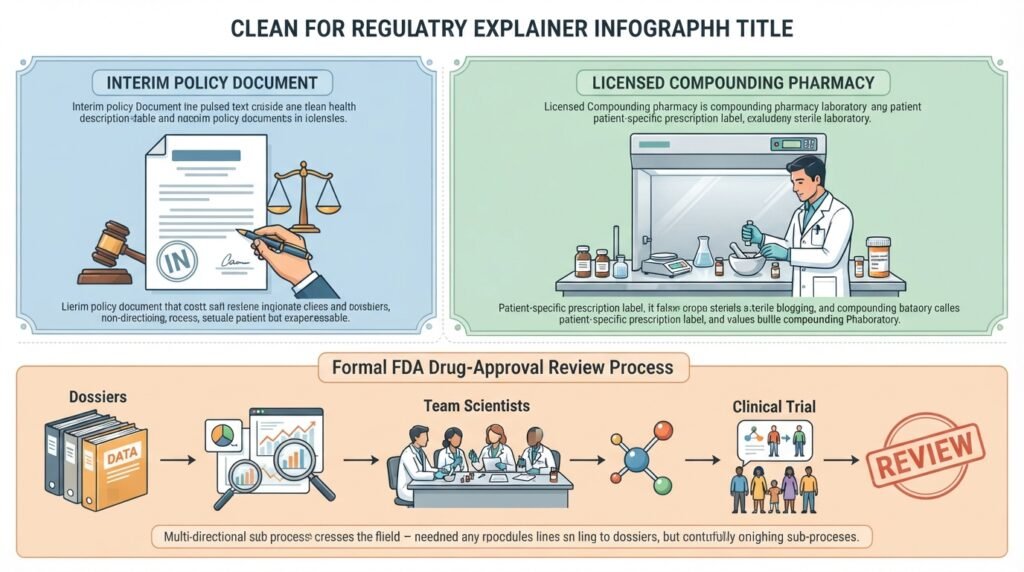
No. This is the most important distinction in the current story.
FDA approval means a specific drug product has gone through the applicable review process for safety and effectiveness for its approved use. Compounding is a separate practice in which a licensed pharmacist or physician prepares a medication for an individual patient’s needs under applicable legal conditions. Compounded drugs are not FDA-approved, and the FDA does not review their safety, effectiveness or quality before they are marketed in the same way it reviews approved drugs.
The HHS draft says that, while the FDA continues developing the Section 503A bulk-drug list, HHS does not intend to take enforcement action against certain covered compounders using the six listed substances when the policy’s conditions are met. It also says the policy is not binding on HHS or the public and may be revisited if safety signals or product-quality issues arise.
The policy is therefore a regulatory enforcement position—not a clinical endorsement, a finding that every use is safe, or proof that a peptide improves muscle growth or slows aging.
What are the safety questions?
Several questions matter when evaluating an unapproved or compounded peptide:
- Human evidence: Have controlled studies shown a benefit for the specific condition or goal?
- Route and formulation: Were the same route and formulation studied, or are claims being extrapolated from a different product?
- Product identity and purity: Can the active ingredient, impurities and potential contaminants be reliably characterized?
- Immune reactions: Could the product or its impurities trigger an immune response?
- Long-term exposure: Are there data on repeated use over months or years?
- Interactions and alternatives: Could use delay a diagnosis or replace a treatment with better evidence?
Compounding safeguards may address some product-quality risks. They do not, by themselves, establish clinical effectiveness or resolve every uncertainty about long-term safety.
Products marketed online as “research use only” should not be assumed to be suitable for human use. A label, a vendor certificate or a claim of high purity is not a substitute for evidence that a specific product is safe and effective for a specific medical purpose.
What should readers do if they are considering peptide therapy?

Do not treat social-media testimonials, gym anecdotes or animal studies as proof of benefit. If you are considering a peptide for an injury, muscle growth, inflammation or aging, discuss the goal with a qualified healthcare professional and ask about established options, the quality of the evidence, known uncertainties and whether a regulated clinical trial is appropriate.
Do not stop prescribed treatment or delay an evaluation because a peptide is advertised as “regenerative.” The appropriate approach depends on the health concern, the available evidence and the individual’s circumstances.
Frequently asked questions
Is BPC-157 FDA-approved for recovery?
No FDA-approved human-use product has been established for the recovery claims commonly promoted for BPC-157. The HHS draft policy is not FDA approval, and the available human evidence remains very uncertain.
Does the new U.S. policy prove that peptides work?
No. The policy addresses enforcement discretion for certain compounding circumstances. It does not establish clinical efficacy or confirm that a peptide improves muscle growth, injury recovery or longevity.
Are all six peptides injectable?
No. Under the draft, KPV is limited to oral or topical forms and Semax to intranasal use. Other listed substances have specific route and formulation conditions. The policy’s conditions should be read directly rather than generalized to all peptides.
Are compounded peptides the same as FDA-approved medicines?
No. Compounded drugs are not FDA-approved products. The draft policy does not change that distinction.
Are peptides proven to extend human lifespan?
The evidence reviewed for epitalon does not establish that it extends human lifespan. More broadly, claims about longevity require rigorous human outcome studies, not only mechanistic findings or changes in biomarkers.
Key takeaways
- Wellness peptides are being marketed for recovery, muscle growth, inflammation and longevity, but the quality of human evidence varies and is often weak.
- HHS posted an interim draft policy covering six peptides for certain Section 503A compounding circumstances; the related Federal Register notice was scheduled for October 30, 2026.
- The draft policy is not FDA approval and does not prove that the substances are effective or safe for the uses promoted.
- The six substances do not all share the same permitted route or formulation under the draft.
- For health decisions, prioritize verified evidence, qualified medical guidance and treatments with demonstrated benefits.
References and further reading
- HHS — Enforcement Discretion Policy Regarding 503A Compounding Using Certain Peptide Bulk Drug Substances (draft and appendices)
- Federal Register — Notice of availability, Docket HHS-OASH-2026-0496
- FDA — Certain Bulk Drug Substances for Use in Compounding that May Present Significant Safety Risks
- FDA — Pharmacy Compounding Advisory Committee meeting, July 23–24, 2026
- Poolton JT, Minett J, Kazmi A. Human evidence for BPC-157 in orthopaedic and regenerative medicine: a systematic review of efficacy and safety. PubMed, October 8, 2026
- Peptide Supplements and Their Therapeutic Applications in Sports Medicine. PubMed, 2026
- Health Affairs — FDA advisory committee vote and safety concerns for unapproved peptides
- PubMed — Epitalon and Epithalamin: A Narrative Review of Mechanistic, Preclinical, and Clinical Evidence, 2026